Future Outlook

Future Outlook

Explore how policy bundles and future contexts affect the 7 key areas of the food system data economy over time.

How this tool works

This tool is built on system dynamics model of the Data Economy for Food Systems (DE4FS). It allows you to explore impact in two ways and see how the system evolves across 7 key areas over time.

The model uses a set of parameters that can be adjusted. Each parameter influences the system and its outcomes. There are 2 ways to explore the potential impact on key areas.

Go to 'Policy Impact' to focus on specific policy bundles. Select a policy bundle (e.g. Data Governance) and the model applies the corresponding changes and shows how the 7 key areas evolve over time under that bundle.

Go to ‘Context Impact’ to discover the impact of the future context. Choose a future context that defines the broader environment. Next, select a strategic option (policy intervention layer). The model combines both and shows the resulting impact on the 7 key areas.
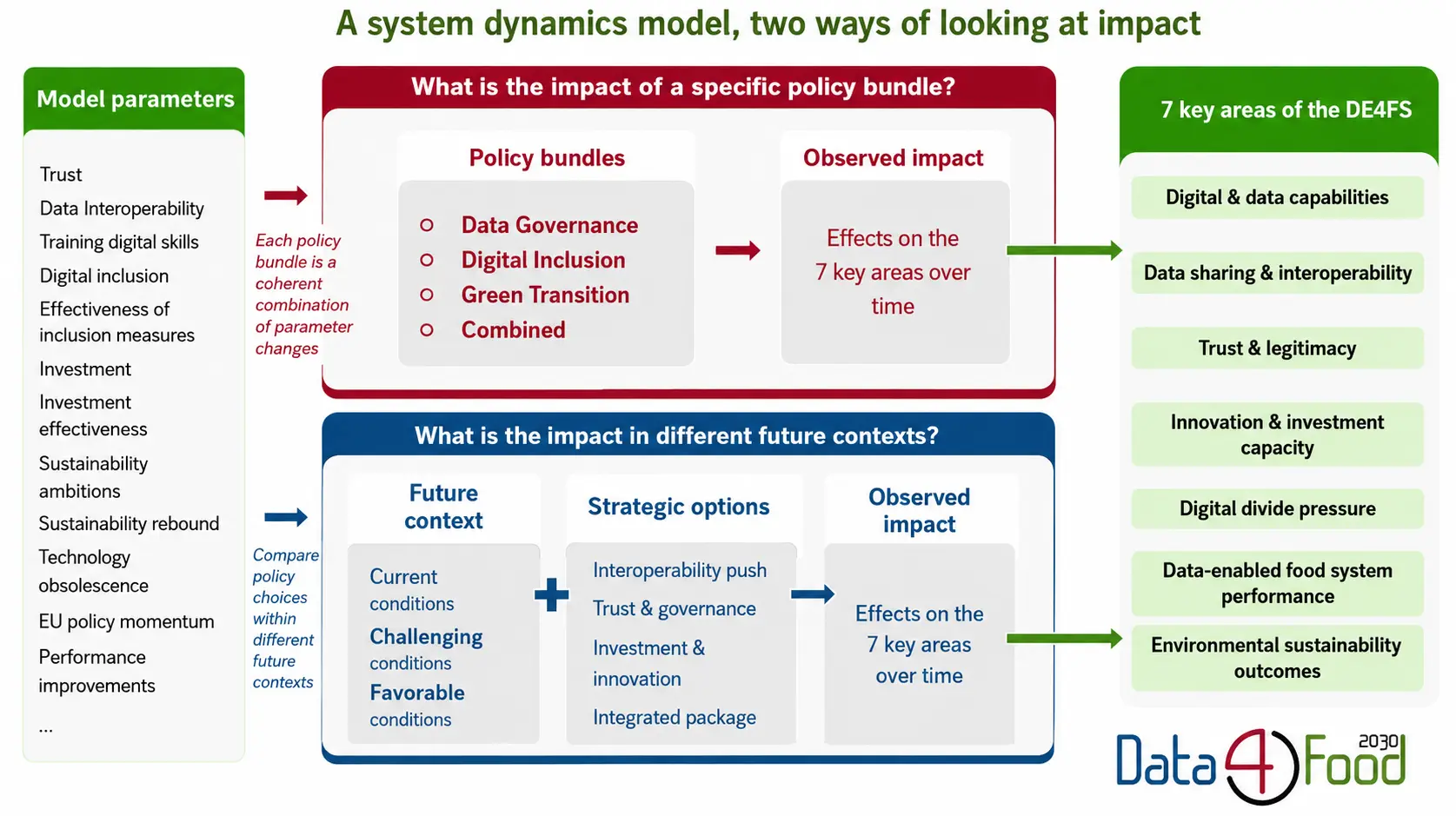
System dynamics model structure with policy bundles, future contexts, strategic options, and 7 key areas

7 key areas shown in the graphs

Digital and data capabilities

The ability of farms, firms, and public actors to use digital tools, data, and skills effectively — supported by digital skills efforts, broadband and digital infrastructure, and CAP-backed innovation and digital farming measures.

Data sharing & Interoperability

How well data can be exchanged and connected across systems and organisations — linked to CEADS and other agricultural data-space initiatives, the Data Act and Data Governance Act, and practical interoperability work such as APIs, standards, Gaia-X, and connectors.

Trust & Legitimacy

The level of confidence that data sharing is fair, protected, and worthwhile — shaped by governance rules, GDPR-related protections, the EU Code of Conduct on Agricultural Data Sharing, and emerging data-space governance models.

Innovation & Investment Capacity

The ability to develop, finance, and scale new data-driven solutions — linked to research and innovation support, CAP encouragement of technology uptake, and investments in agri-food data services, platforms, and start-ups.

Digital Divide Pressure

The extent to which weaker connectivity, lower skills, smaller farm size, or limited resources hold parts of the system back — a challenge addressed through CAP rural support, fairer income distribution, and targeted inclusion and training measures. Lower is better.

Data-enabled Food System Performance

How much better data use improves coordination, traceability, efficiency, and decision-making across the food system — for example through farm decision support, supply-chain monitoring, sustainability reporting, or food-waste reduction.

Environmental Sustainability Outcome

The extent to which digital progress also supports greener outcomes — linked to Farm to Fork, the Green Deal, FSDN-based sustainability monitoring, circular economy actions, and efforts to reduce waste, emissions, and resource use.